Circuit breakers are important protection and control devices in power systems, and their opening and closing performance directly affects the safety and stability of power grid operation. Mechanical characteristic testing of circuit breakers is an indispensable inspection work in substations, power maintenance sites, and the production process of high-voltage switchgear. Among them, parameters such as opening and closing time, synchronicity, bounce time, and stroke are important criteria for determining whether the mechanical performance of the circuit breaker is normal.
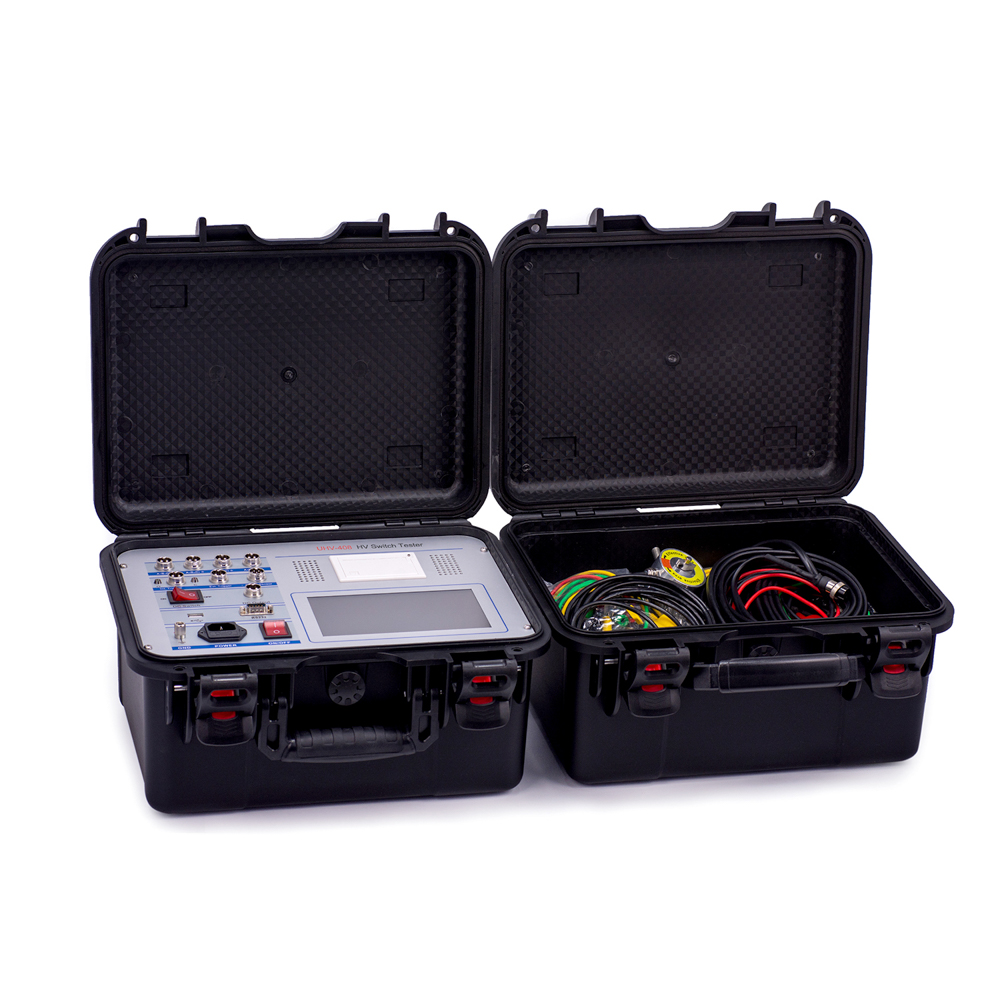
그만큼Circuit Breaker Timing Tester is mainly used to measure the time parameters of circuit breakers during the opening and closing processes, helping technicians understand whether the switch actions are accurate, whether the actions of each phase are coordinated, and whether there are abnormalities in the mechanical transmission mechanism. How to choose a suitable circuit breaker time tester for different voltage levels, structural types, and testing requirements is a problem that power operation and maintenance units and equipment procurement personnel need to consider.
Select testing equipment based on the type of circuit breaker
There are certain differences in the structure and operation mode of different types of circuit breakers, and the required testing channels and sensor configurations are not completely the same.
Common test objects include vacuum circuit breakers, SF6 circuit breakers, GIS combination devices, oil circuit breakers, and high-voltage AC circuit breakers. Some equipment adopts a three-phase linkage structure, while some high-voltage circuit breakers adopt a phase separation operation method, which has different requirements for the number of channels and testing functions of the tester.
Before procurement, it is necessary to clarify the type, number of poles, operating mechanism, and contact structure of the circuit breaker that needs to be tested on site, and confirm whether the instrument supports the corresponding testing method. For users who need to test multiple types of circuit breakers, it is recommended to choose equipment with strong universality and flexible testing channel configuration to meet the usage needs of different projects.
Pay attention to the ability to measure the opening and closing time
The opening time and closing time are the core parameters in the mechanical characteristic testing of circuit breakers.
The opening time usually refers to the time it takes for a circuit breaker to receive an opening instruction, from the issuance of relevant operation signals to the separation of contacts; The closing time reflects the time elapsed from the issuance of the closing command to the contact of the contacts. By measuring these parameters, it is possible to determine whether the circuit breaker action meets the technical requirements of the equipment.
When selecting equipment, attention should be paid to the time measurement range, resolution, and measurement accuracy of the instrument. For high-voltage circuit breakers and precision testing projects, it is important to confirm whether the equipment can accurately record millisecond level action time and meet the testing requirements of different types of circuit breakers.
In addition, attention should be paid to whether the instrument can measure the opening and closing time of phases A, B, and C separately, in order to avoid affecting testing efficiency due to insufficient channels.
Check the three-phase synchronicity testing function
During the actual operation of the circuit breaker, the three-phase contacts need to complete the opening and closing actions in the prescribed time sequence. If there is a significant time difference between the three phases, it may lead to unbalanced operation in the power system, affecting the operational performance of the switchgear.
Therefore, three-phase synchronicity is a key consideration when choosing Circuit Breaker Timing Tester.
A fully functional circuit breaker time tester should be able to measure the synchronization of three-phase opening and closing, as well as the phase to phase time difference, and visually display the action of each phase through data or curves.
For testing objects such as high-voltage circuit breakers and GIS equipment, it is recommended to choose instruments with multi-channel synchronous acquisition capabilities to ensure accurate recording of phase data during the same testing process, facilitating comparative analysis by technical personnel.
Confirm bounce time and travel testing function
In addition to the opening and closing time, the contact bounce time and mechanical stroke are also important parameters for determining the operating status of the circuit breaker.
When the circuit breaker is closed, if there is repeated separation and contact between the moving and stationary contacts after contact, it will cause contact bounce. Excessive bounce time may increase contact wear, affecting the electrical performance and service life of the equipment.
The travel test is mainly used to detect the movement distance of the moving contact of the circuit breaker during the opening and closing process, including the total travel, opening distance, overtravel, and related speed parameters.
When selecting equipment, it is important to understand whether the instrument supports bounce time measurement and whether it has accompanying travel sensors and speed calculation functions. For users who require comprehensive mechanical characteristic testing, it is recommended to choose a comprehensive circuit breaker mechanical characteristic tester that can simultaneously complete time, speed, stroke, and bounce tests.
It should be noted that the installation methods and stroke parameter definitions of sensors for different types of circuit breakers may vary. When purchasing, it is necessary to confirm whether the matching sensors are suitable for the on-site equipment.
Pay attention to sensor configuration and installation methods
Sensors are an important component of the mechanical characteristic testing of circuit breakers, and their configuration directly affects the integrity of the testing items and the efficiency of on-site operations.
Common sensors include linear displacement sensors, rotation sensors, and acceleration sensors. The mechanical transmission structures of different circuit breakers may vary, and the types of sensors used may also differ.
For example, some vacuum circuit breakers can detect contact travel through linear displacement sensors, while some circuit breakers that use rotary transmission mechanisms require the use of corresponding rotary sensors.
Users should provide information such as the circuit breaker model, manufacturer, and structure before purchasing, so that the supplier can confirm whether the sensor configuration and installation accessories match. If a tester needs to serve multiple on-site projects, the universality and ease of replacement of sensor accessories should also be considered.
Choose the appropriate operating method for on-site work
Circuit breaker time testing is usually conducted at substations, switchgear installation sites, and power equipment maintenance sites, so the convenience of instrument operation and on-site adaptability are equally important.
Suggest paying attention to the following aspects:
Firstly, the instrument should have a clear operating interface that allows for easy setting of opening, closing, and related testing parameters, reducing on-site operation time.
Secondly, the equipment should have data storage and historical record query functions, making it easy for technicians to save the detection results of different circuit breakers and compare the data before and after maintenance.
In addition, the generation and export functions of test reports are also worth paying attention to. A device that supports data storage, printing, or exporting test results via USB, making it more suitable for daily power testing and equipment maintenance work.
For users who frequently conduct outdoor testing, attention should also be paid to the size, weight, power supply method, and anti-interference ability of the instrument to ensure that the equipment can adapt to the on-site testing environment.
Pay attention to safety protection and anti-interference ability
The testing site of circuit breakers usually involves high-voltage switchgear and its control circuits, and the safety during the testing process cannot be ignored.
When purchasing, it is necessary to understand whether the instrument has corresponding input protection, overvoltage protection, and wiring inspection functions, and test whether the cables and accessories meet the actual usage requirements.
At the same time, there may be strong electromagnetic interference at the substation site, and the signal acquisition capability and anti-interference performance of the instruments will affect the stability of the measurement results. It is recommended to choose equipment with reliable signal isolation and anti-interference design, and confirm its suitability for actual testing environments.
It should be noted that the protective function of the tester itself cannot replace on-site safety measures. Before testing, power outage, electrical inspection, grounding, and safety isolation should still be completed in accordance with relevant regulations.
Understand the manufacturer's technical support and after-sales service
그만큼circuit breaker time tester is not only a detection device, but also involves technical aspects such as sensor configuration, testing wiring, parameter setting, and data analysis. Therefore, the technical service capabilities of suppliers should also be considered in procurement.
Manufacturers with relevant product development and production experience are usually able to provide corresponding equipment configuration recommendations based on the user's circuit breaker model and testing requirements.
When purchasing, it is important to understand whether the manufacturer can provide product operation instructions, on-site wiring guidance, remote technical support, software upgrades, and equipment maintenance services. If users have special testing requirements, they can also communicate in advance about the configuration of testing channels, sensor types, and data management functions.
For overseas buyers, it is also important to understand whether the equipment supports English operating interfaces, English manuals, and international transportation and export services to reduce communication costs during subsequent use.
Choosing Circuit Breaker Timing Tester should not only focus on equipment price and basic time measurement functions, but also need to be comprehensively judged based on circuit breaker type, testing channel, synchronization measurement, bounce detection, travel sensor configuration, and on-site usage environment.
For power testing units that require comprehensive mechanical characteristic testing of circuit breakers, it is recommended to prioritize equipment with complete functions, stable measurement, easy operation, and reliable after-sales service. Appropriate testing equipment can improve on-site detection efficiency, provide reliable data support for circuit breaker status assessment, daily maintenance, and troubleshooting, and also help ensure the long-term safe and stable operation of the power system.